Monday, 11 April 2016

Evaulation- Question 4- Imogen Evans

Who would be your target audience for your media product?


Our target audience for 'Unanswered' is Teenagers and Young Adults, specifically 15-24 because the film has Teenagers in and is produced by Teenagers, therefore giving it the perfect target audience and also because Teens and Young Adults are the target audience for Thriller Films.


As you can see below the age group 15-24 attend the cinema the most, this has been sourced from the Pearl & Dean website. Click here to read the whole page.


In the picture shown above, across 3 months 25 films out of 39 films have target audience of ages 15-24, proving teenagers and young adults are the best age to target audience our film at.

The films shown above are films 15-24 like to watch, a similar film to 'Unanswered' is 'The Conjuring 2' this is also a spooky thriller/horror film which our target audience will like.
Click here to watch the trailer.


Sunday, 10 April 2016

Evaulation- Question 2- Imogen Evans

How does your media product represent particular social groups?


The most popular social groups which could have been represented in our film are:


Gender,
Age,
Sexuality,
Ethnicity,
Class & Status,
Ability & Disability,
Regional Identity


We chose to represent the titles highlighted in red.


By choosing to represent teenagers and a middle class status it reflects on the creators of our media products as we fit under these social groups. This gave us first hand knowledge on how to portray our characters and how to fit them into chosen scene scenarios, an example; we knew how a teenager would react to their mother dying, so we gave our ideas to our actor.
Using a different age range it would be harder to portray emotions like we did with a teenager.

How have these representations been constructed through the use of technical codes?


Camera:  A close up is used when the main teenage character is smoking a cigarette which constructs rebellion and a sign of getting older and mature. By using a close up it also emphasises the characters facial expressions of him sighing out of stress and pain which is common AMONGST TEENAGERS.


                                                      Here it is shown the protagonist releasing stress


Mise En Scene:


Props- We focused on using a cigarette as that constructs can drama and it can reflect the growing of a teenager by rebelling and turning to cigarettes. Cigarettes can also emphasise the emotional and stressful times the character is facing, smoking is part of him growing up and learning about who he is.


Costumes- The main character wore a causal superdry jacket and his teenage friends wore hoodies. This constructs their teenage image and age, superdry is an expensive brand which shows
his middle class status.


                                                                           The superdry jacket vs the black coat


In contrast the elder antagonist character wore a longer black coat which constructs age to the film, it emphasises the maturity level between each character as an someone older would not wear a superdry hoodie.


Positive or negative representations, modern or traditional?

The main teenage character is given a negative representation due to him being out late in the dark and smoking which links to the way grief has changed him. In an adults perspective he would be a negative representation but at iseajh we see a positive representation as it is only human to act out when pain strikes.


It is a modern representation of a teenager as it shows modern material goods such as his clothing and cigarettes. By setting the end scene in a college it represents a teenager in a modern day lifestyle.
                                      Here is our main character in his stereotypical superdry jacket

Why have you chosen to represent characters in this way?

We have chosen to present the main character whom is the protagonist in a angry but innocent style to make the audience sympathize for him for losing his parents. We make the audience sympathize the main character by making the actor have emotional facial expressions through out the opening.


An example is that when he bangs the railing he clenches his face and bows his head as if to show he is trying not to cry. As shown above


We have tried to make the audience dislike the antagonist by hiding his identity which will make the audience wonder who he is and what link does he have towards the main character. By giving him a bloody scar this makes the audience dislike the antagonist as they will believe it is out of bad decisions he has this scar.


These are the traits which the audience will dislike the antagonist

Within our opening we have not decided to set out to challenge stereotypes but instead follow stereotypes of a white middle class teenage boy. We followed stereotypes as we wanted our film to be as natural as possible so it looked like it could be happening in the present day which is why we chose to film in a college and locations people could recognise 'Worth Church'.

A character profile of Tom our stereotypical white boy.
                                     If we had put more thought into stereotypes we may have used a different specific group but because we did not have many actors on hand and it was more convenient we chose to stick with what we knew best and what we could link together, two white men who could bare a resemblance.


In contrast to other thriller films I looked at, it does not show any stereotypical white middle class boys. An example that in 'The Lovely Bones' there are no stereotypes within the film so by us creating the stereotypical image it is showing a different angle.
Considering 'The Lovely Bones' and 'Unanswered' were set in different time periods it is different but 'The Lovely Bones' considerably focuses more on the females in their opening whilst our opening is male dominated due to the link between Father and Son.


The Lovely Bones is set in 1973 whilst Unanswered is set in 2016.

Here is the difference between the time periods: The Lovely Bones vs Unanswered


Evaluation- Question 1- Imogen Evans

In what ways does your media product use, develop or challenge forms and conventions of real media products?

In my thriller research, I looked at, Kill List, Silence Of The Lambs, Lovely Bones and Pulp Fiction, which all follow the usual criteria of the thriller genre, having a protagonist and antagonist in it, creating enigma and using restricted and unrestricted narration.


Unrestricted narration is the term used to explain whether the audience knows more information or is presented with more information than the character is.
Restricted narration is the term used for when the film is filmed in the characters point of view only so the audience only know what the character knows.


EXAMPLE: The Lovely Bones
The opening of 'The Lovely Bones' is all set using restricted narration. This is used so it doesn't give too much of a hint of what is going to happen in the rest of the film. There are subtle moments which uses unrestricted moments to give the audience moments of realisation that something has happened to the main character.


                                                                Here it is shown


The subtle match on action on the picture and how the light turns off as the picture is in mid shot, it expresses that something has happened to this character, therefore unrestricted narration.


OUR FILM:
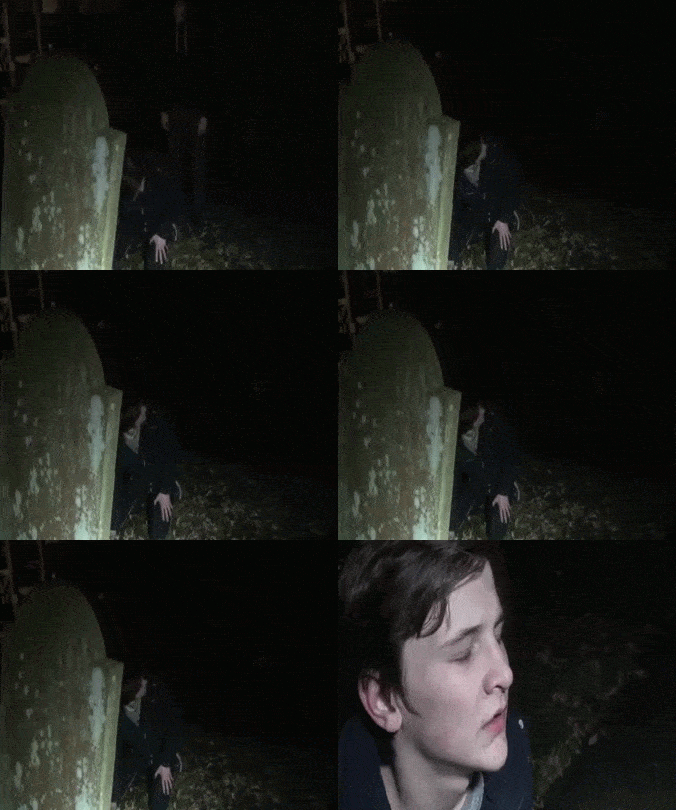
We used unrestricted and restricted narration in our film because throughout it was in the eyes of our main character and that was all the audience would see. In the graveyard scene we used restricted narration to make it look like the antagonist was not there, this allowed the audience to realise something mysterious was happening,


                                                     Here is the antagonist disappearing


We based our thriller opening titling from  'The Lovely Bones' which has an iconic opening which created enigma and set the storyline up well with it's use of fades and transitions. We took inspiration from the use of titling in 'The Lovely Bones' as we thought it helped start the scene off well and didn't give too many hints.
                                                 On the left 'The Lovely Bones' on the right 'Unanswered'
Throughout the rest of the opening we continued to take some aspects from 'The Lovely Bones' because we used the same idea of cutting from different moments in the life to show momentum and nostalgia. This has been shown using familiar locations as 'The Lovely Bones' used childhood memory locations and we used sentimental locations which the main character would feel nostalgic from.


We filmed our thriller at night which represents danger and panic, we based this on 'the Usual Suspects' opening which was filmed at night and based it's theme of panic and ENIGMA as it left the audience wanting more from the scene when it ended on a cliff hanger. By choosing to film at night and having a mysterious Antagonist which you can't fully see it's identity like in The Usual Suspects it created enigma and tension which was emphasised by the use of low key lighting.


Both of these shots look very similar as we took inspiration from The Usual Suspects. A key idea we copied is not showing all of the antagonist because it emphasises the enigma of the scene and gives mystery as you have no idea who he is.

Friday, 8 April 2016

Evaluation - Question 5 - Amy Homewood


Question 5- How did you attract/address your audience?

Our film will appeal to our audience as we have left open media product on such an open ending; the story could continue in many different ways. The speculation will leave them hanging. I also feel like our film that has not been done in mainstream-media for quite a while; our main character really does have multiple sides to his personality, his main emotions being anger and sadness within the first few minutes in the film. A lot of killers in mainstream-film give their characters a straight-forward narrative with progression and basic background. We have a huge degree of complexity behind ours as you do not see much of our antagonists characteristics and apart from the voice over, the audience is left very clueless on what is actually going on.

I feel that our protagonist appeals to our audience as we never quite know how to feel about him. He is very stereotypical to his social group and isn't particularly a social star with the amounts of friends he has- unlike many other murderers within the Thriller genre. 


The character was designed to look sleep-deprived, distant and dirty with his very plain, unsaturated clothing. Smoking as a way to escape from everything and just the overall emotion of sadness and anger.

Many Horror/Thriller films like the idea of creating a sad characters effects on what has happened to them previously (a death maybe) such as; Side Effects (2013). An American psychological thriller film directed by Steven Soderbergh from a screenplay written by Scott Z. Burns. The film concerns the ramifications of an event following a young woman being prescribed antidepressant drugs and cigarettes, in particular the fictional new drug Ablixa (alipazone) as use of an escapism.


Our protagonist could be likened to the characters that have been placed within side effects as:
  • Tired and not happy
  • Psychologically twisted 
  • Not visually disfigured
  • Dresses in day-to-day clothing 
  • White males
  • Personality is shown through facial expressions (anger or sadness)
Films like this is a cult-classics, and have all received a rating of 8.5 or above on IMDB. Here a few other thrillers with a similar theme- 2 of them being a thriller based book and the other a thriller film:

Film 1
Film 2
Film 3

Our antagonist also has this distant personality and smug-ridden face - all the ingredients needed for a killer in this genre. Including the scar on his face. This is also a very safe option, as this character type has clearly been done before and the use of scars and gore also adds to the genre experience. 

Evaluation - Question 4 - Amy Homewood

Question 4- Who would be the audience for your media product?

Our target was originally for the stereotype of what a thriller movie would usually be aimed at, which is 14+ teenagers, particularly male. 

However, it seems that our opening shows more of a 15+ film as it shows a lot more gore than what is the allowed amount for a 14+. 

Our audience would have to have an interest in murder mystery but also have a soft side towards the death of somebody in their family in order to really connect with our antagonist and the way in which he is feeling due to the loss of his mum.


The current BBFC system is:
  • Uc – Especially suitable for pre-school children. The category is now retired, although older video works still in circulation may carry the label.
  • U (Universal) - Suitable for all. A U-rated film should be suitable for audiences aged four years and over.
  • PG (Parental Guidance) - General viewing, but some scenes may be unsuitable for young children. A PG-rated film should not unsettle a child aged around eight or older.
  • 12A - Cinema release suitable for 12 years and over. No one younger than 12 may see a 12A-rated film in a cinema unless accompanied by an adult.
  • 12 – Video release suitable for 12 years and over. Video recordings with this rating are not to be supplied to anyone below that age.
  • 15 - Suitable only for 15 years and older. No-one under 15 is allowed to see a 15-rated film at the cinema or buy/rent a 15-rated video.
  • 18 - Suitable only for adults. No-one under 18 is allowed to see an 18-rated film at the cinema or buy/rent an 18-rated video.
  • R18 (Restricted 18) - Adult works for licensed premises only. The R18 category is a special and legally restricted classification primarily for explicit works of consenting sex or strong fetish material involving adults. Films may only be shown to adults in specially licensed cinemas, and video works may be supplied to adults only in licensed sex shops. R18-rated video works may not be supplied by mail order.

The British Board of Film Classification 15 rating

What does the 15 symbol mean?No-one under 15 is allowed to see a 15 film at the cinema or buy/rent a 15 rated video. 15 rated works are not suitable for children under 15 years of age.

Are there any limits on what sort of theme a work can have at 15?No theme is prohibited, provided the treatment is appropriate for 15 year olds.

What might I see in a 15 rated film or video?

Any of the following:
  •  Strong violence
  •  Frequent strong language (e.g. 'f***').
  •  Portrayals of sexual activity
  •  Strong verbal references to sex
  •  Sexual nudity
  •  Brief scenes of sexual violence or verbal references to sexual violence
  •  Discriminatory language or behavior
  •  Drug taking"
Can you see drugs in a 15 rated film or video?
The misuse of easily accessible and highly dangerous substances like aerosols or solvents is unlikely to be acceptable at 15.

What about dangerous behaviour or things teens might copy?
Whether the depiction of easily accessible weapons is acceptable will depend on factors such as realism, context and setting.
At 15 drug taking may be shown but the work as a whole must not promote or encourage drug misuse (for example, through instructional detail).
We consider the risk of potential harm to impressionable teenagers. For example, dangerous behaviour such as hanging, suicide and self-harming should not dwell on detail which could be copied.
15 – for 15 year-olds and over
No one younger than 15 can go and see a 15 rated film in the cinema. No one younger than 15 may rent or buy a 15 rated video, DVD or download.

General / Age rating issues at 15

15 rated films, videos and downloads can contain strong material including strong swearing, strong horror and strong violence.

For example the film 'Lovely Bones' is the idea that we based our whole thriller opening off. Within the film it centers on a young girl who has been murdered and watches over her family - and her killer - from purgatory. She must weigh her desire for vengeance against her desire for her family to heal.

Lovely bones is rated a PG13- Here is the ratings on the film:


Therefore I would like to say that ours would be either a U or a 15 based on the lovely bones review.